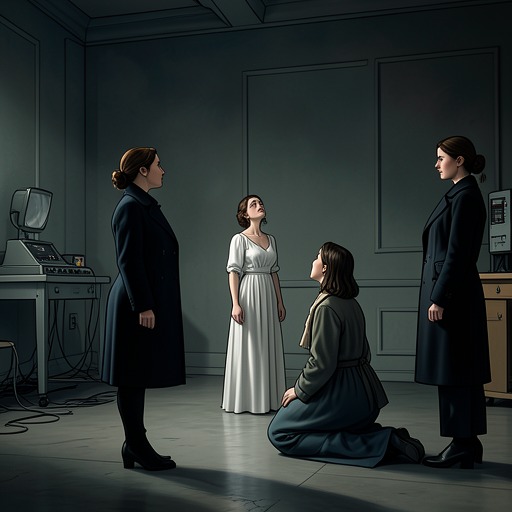
Gerda Christow
The HollowGerda Christow is at once the most underestimated person in the household and the hidden agent of John Christow's murder. Seen by others as slow, submissive, and dependent, she converts those assumptions into camouflage: after killing her husband, she stages the scene so that suspicion falls on everyone except herself, while Henrietta Savernake and the Angkatell family help preserve the appearance she has created.
Identity and Domestic Position
Gerda's marriage to John Christow is marked by an asymmetry that John recognizes but cannot escape. He sees her patience, unselfishness, and habit of subordinating her wishes to his as virtues, yet those same qualities increasingly irritate him. Her readiness to admit that she is wrong, her refusal to hold firmly to an opinion against him, and her failure to assert an independent course provoke his ill temper. The contradiction is central to their marriage: John chose a woman whose submission made domestic life easy, then resented the very submission on which that ease depended.
Gerda's position is also defined by her isolation from the Angkatell household. The weekend at The Hollow is a source of dread rather than pleasure. She experiences Lucy Angkatell's unfinished sentences and abrupt inconsequences, as well as the presence of the other guests, as bewildering and oppressive. She endures the visit for John's sake, while John welcomes the country weekend as something that will do her good. His confidence in the restorative value of the visit only sharpens the distance between his understanding of her and her private experience of it.
Wounded Marriage and Emotional Misrecognition
John's infidelity and divided affections become the emotional ground of Gerda's crime. She later tells Henrietta that she had believed his earlier attachment to Veronica Cray was over, and that the image she had formed of her husband collapsed when she saw his face as he followed Veronica. Her revelation that everything she had believed about John was a lie shows that the murder is not presented by her as a calculated response to one isolated insult. It follows the destruction of an idealized marriage and of the identity she had built around being John's wife.
John's relationship with Henrietta intensifies Gerda's sense of displacement. Henrietta explains that John had tried to keep their affair light and easy because he feared beginning to love her and did not want emotional entanglement. Yet Henrietta also understands that John loved Gerda more deeply than he had understood, because Gerda belonged to him in the possessive sense that mattered to him. Gerda therefore occupies the paradoxical position of being undervalued in daily life but central to John's deepest sense of attachment. The marriage that appears to reduce her becomes the bond he cannot finally abandon.
The Murder and the Staged Innocence
At the pool, the woman holding the revolver initially appears bewildered by the discovery that John is dead. Gerda later recounts that she went to the swimming pool shortly before one o'clock, having looked at the clock and noted the time as approximately two minutes to one. Her account of finding John lying beside the pool, with blood on the concrete edge, is both a report of the crime scene and part of the performance by which she presents herself as a shocked witness rather than the killer.
Her plan depends on two revolvers. Sir Henry Angkatell had shown her how to load and fire one that afternoon, and she had read in the detective story The Clue of the Dripping Fountain about the police being able to identify the gun from which a bullet had been fired. She therefore intended to shoot John with one revolver, hide it, and remain holding the other. Investigators would first assume that the gun in her hand had fired the shot; when the evidence showed that it could not have done so, they would conclude that she had not committed the murder. The plan turns forensic knowledge into theatrical misdirection, using the appearance of an obvious mistake to manufacture exoneration.
Gerda's confidence in the plan rests on her awareness of how others see her. She tells Henrietta that people mistake slowness and staring for stupidity, while she can remain inwardly alert and even amused by their assumptions. Her self-presentation as the harmless, mentally limited wife is thus not merely a social description imposed on her; it becomes an instrument she deliberately operates. The apparent simplicity of her behavior conceals a highly organized attempt to control what the police will infer.
The Collective Cover-Up
Gerda's concealment succeeds because the scene is not designed to implicate one alternative suspect but to distribute suspicion across the entire household. Henrietta Savernake recognizes that the pattern repeatedly points away from Gerda Christow while offering suggestive but inconclusive suspicions of David Angkatell, Edward Angkatell, and Lady Angkatell. Ygdrasil is deliberately planted to attract attention and even to bring Hercule Poirot himself under suspicion. Lady Angkatell, understanding what is happening, repeatedly diverts Inspector Grange, while the wider family assists as soon as its members understand the protection Gerda requires.
This arrangement changes the meaning of Gerda's apparent passivity. The family does not simply fail to see her; it helps maintain the role she has chosen to play. Their interventions turn a private murder into a collective moral operation in which loyalty, family feeling, social manners, and pity compete with the demand for factual responsibility. Gudgeon's formal, almost feudal service to the household and Lady Angkatell's conversational treatment of that service belong to the same atmosphere: the established order protects its own, even when protection requires obstructing the investigation.
Henrietta's participation has a further emotional cause. When Hercule Poirot asks why she helped, she explains that John's final word, Henrietta, was a request to protect Gerda. She believes he loved Gerda more than Veronica Cray or herself and understood that Henrietta would do anything he wanted because she loved him. Gerda's survival therefore becomes the object around which the other characters' guilt and sacrifice are organized. She commits the murder, but the household supplies the social machinery that keeps the law from reaching her.
Exposure and Ending
Gerda finally reveals the motive and method to Henrietta. She says that she could not bear what she had seen and had to kill John, then describes the two-revolver plan with triumph. Her explanation is chilling partly because she delivers it conversationally and almost amiably, as though the ingenuity of the device could settle the moral question. She even worries about the leather object left in a drawer in her bedroom, asking whether the police will trouble themselves about the holster. The overlooked physical remnant exposes the gap between her confidence in the performance and the persistence of material evidence.
Poirot concludes that the scene was set from the beginning, though he initially did not understand that Gerda had staged it. He identifies Henrietta's ingenuity as the force he had been confronting and recognizes that her relatives had aided it. Once the brown leather fragments from Henrietta's raffia workbag are fitted together as a holster, the final trace of the scheme is recovered. Gerda's apparent collapse is then treated as an overwhelmed woman's act: the official account will be that she took her own life while of unsound mind, allowing the household's protective fiction to continue even after the truth has been established.
Gerda's ending is therefore neither a simple exoneration nor a straightforward public punishment. She is exposed to Henrietta and Poirot, yet the collective cover-up reshapes the legal consequence of her act. The woman who relied on being underestimated becomes the center of a final act of mercy that repeats the original deception. Her silence, submission, and emotional dependence have concealed a capacity for violence; after the murder, the same household structures that helped conceal her guilt help transform its consequences into a protected tragedy.
Narrative Significance
Gerda embodies the danger of confusing a social role with a complete psychology. John treats her submissiveness as both a chosen marital convenience and an irritating limitation; the family treats her apparent stupidity as evidence that she could not manage a sophisticated crime. She turns both judgments against the people who make them. Her crime is enabled by a chain of misrecognition in which each person sees a fragment of her and mistakes it for the whole.
Her story also reveals how private attachment can override public justice. John Christow's marriage, his affair with Henrietta Savernake, and his past with Veronica Cray create a network in which Gerda's identity is continually measured through John's desire. Yet when that desire appears to be withdrawn or exposed as divided, Gerda acts with a decisiveness that the surrounding characters never imagined in her. The plot's final irony is that her deed is not buried by her own deception alone: it is sustained by Henrietta's love for John, by the Angkatells' loyalty, and by a household collectively willing to convert guilt into protection.